The Indian enigma: why Americans keep misreading a country they think they know.
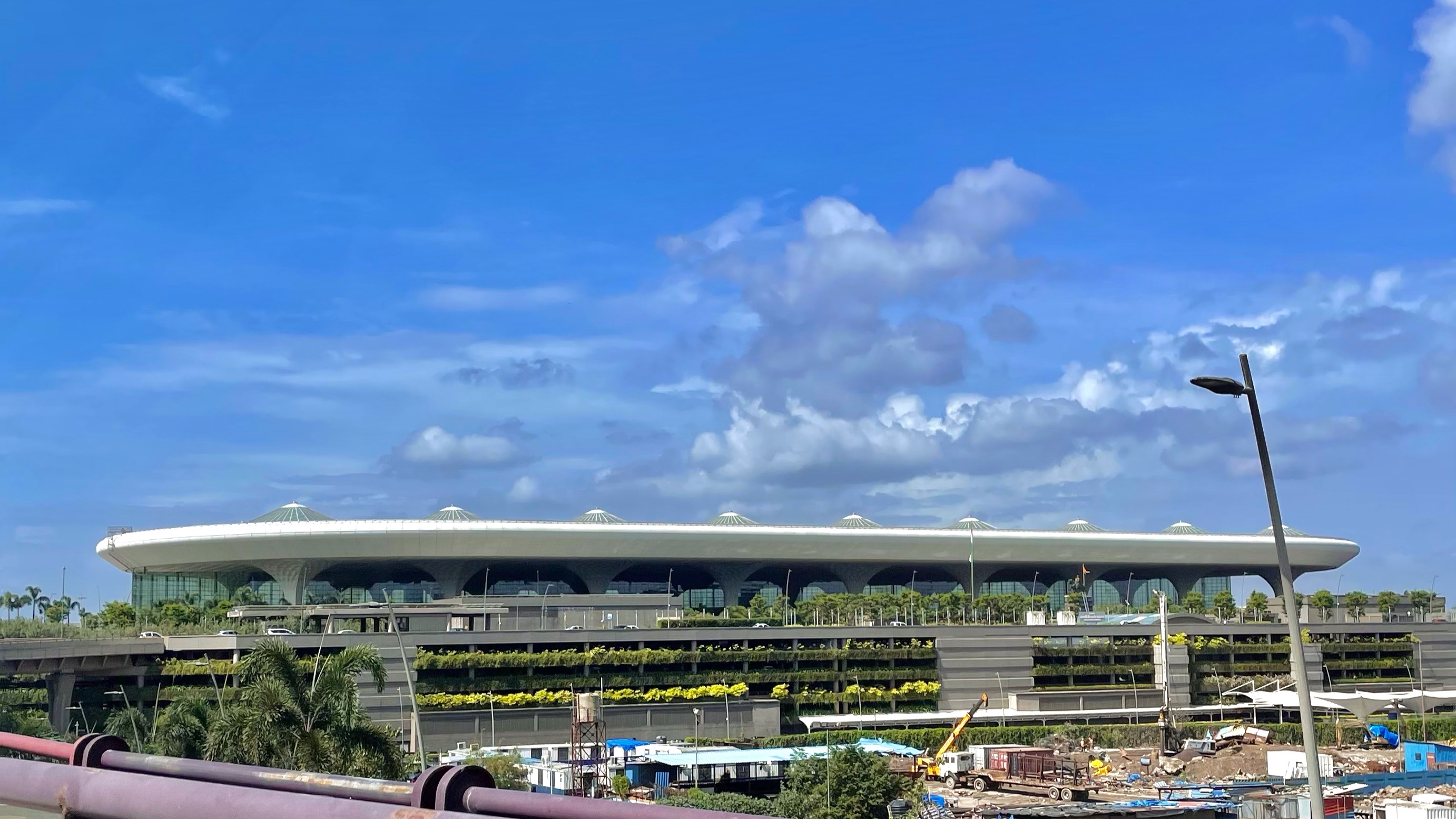
India's impressive progress and lagging priorities
India has built the gleaming projects first. Storm drains and the roads people use every day have waited.
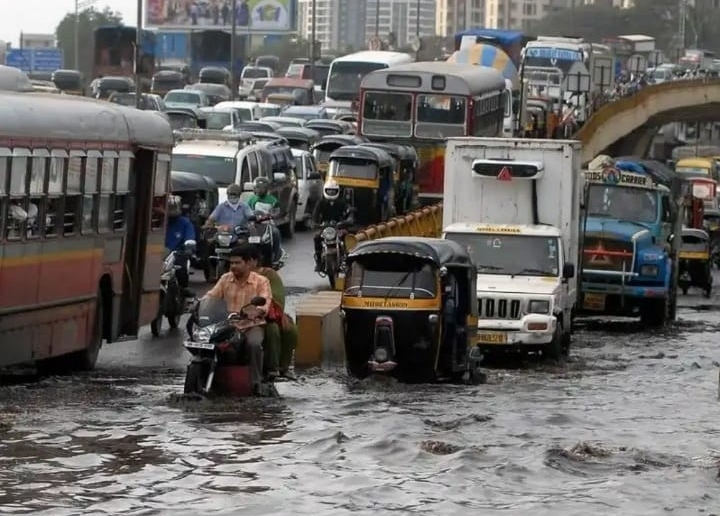
Photos: airport, Anonymous8010 / Wikimedia Commons, CC BY-SA 4.0; flood, Paasikivi / Wikimedia Commons, CC BY-SA 4.0.
Editor's view · First written June 2023 · Updated October 2026
The Indian enigma
Few countries are as misunderstood by Americans as India. Most Americans meet India through its diaspora: enterprising, English-speaking high achievers, part of what The Economist has called a diaspora bigger and more influential than any in history. Add a media narrative of IT prowess, a space program, nuclear weapons and bullet trains, popularized by books such as Thomas Friedman's The World Is Flat, and it is easy to imagine a rising, efficient democracy and a natural ally against China.
The reality is more complicated. By the World Bank's measure, extreme poverty fell from nearly half the population in 1993 to under 3 percent by 2023, but the gains are very uneven. India is decades late on infrastructure, and it has built the easy, flamboyant projects first: gleaming airports and thousands of miles of highways. The difficult, unglamorous work has lagged: storm drains, sewage treatment, safe drinking water, and the inner roads that connect highways to where people actually live. So the highways have not knit the economy together as America's interstates did. Even showcase projects stumble; in Mumbai, a rebuilt bridge failed to line up with the flyover it was meant to join. India records more road deaths than any other country, about 177,000 in 2024 by official count; waterborne disease remains common, and Indian cities have some of the worst air in the world. The economy is not creating enough good jobs for the millions of young people entering the workforce each year, and bureaucracy and corruption make business harder than many American investors expect.
Abroad, India wants a seat at the top table but is selective, even hesitant, about taking it, as its prime minister's absence from this year's UN General Assembly showed. It prizes “strategic autonomy” over alliances, but the doctrine's costs now outweigh its benefits. Buying discounted Russian oil over American objections has been penny-wise and pound-foolish: cheaper fuel at the price of strained ties with India's most important economic partner. Despite agreeing a framework in March, India and the United States had still not concluded a trade agreement by October 2026.
Washington keeps mistaking India's size and talent for readiness to be a dependable partner. The gap between the India Americans imagine and the India that exists is the Indian enigma, and the comments below track it as it unfolds.
— John Laxmi
Editor's comments
-
Indian manufacturing’s moment may finally have arrived
Editor's comment
The Economist · Indian manufacturing's moment may finally have arrived
“Industrial Pradesh”! That is The Economist's name for the belt of states from Gujarat through Maharashtra and Karnataka to Tamil Nadu, which together produce about half of India's manufacturing value. Has anyone heard the term before? The magazine deserves the trademark rights, if not an award, for coining it.
-
IOC confirms India and Qatar as bidders to host the 2036 Olympics
Editor's comment
AP News · IOC confirms India and Qatar as bidders to host the 2036 Olympics
Why is India competing to host the Olympics? Almost every host has run up a large net loss. The exception is Los Angeles in 1984, which used existing stadiums and private funding and, as the only bidder, had the upper hand with the International Olympic Committee. Barcelona (1992) got a boost to its infrastructure but ran up a huge debt; London (2012) revived East London at more than three times its original budget.
India has no particular advantages and faces considerable challenges. The 2010 Commonwealth Games in Delhi brought pride, but also cost overruns, delays and corruption scandals. More important are the opportunity costs: money and national attention diverted from critical human needs.
India's Olympics bid springs from the same impulse that launches bullet trains: a wish to show that India has arrived among the developed countries. It is the impulse that leads some Indian families to splurge on lavish weddings with borrowed money that takes a lifetime to repay.
-
India’s first bullet train stumbles over divisions with partner Japan
Editor's comment
Financial Times · India's first bullet train stumbles over divisions with partner Japan
This report bears out what the editor has argued for years. The bullet train is an example of India's perverse priorities. Indian rail passengers are not clamoring for speed; they lack seats, safety and clean toilets. Unreserved coaches are crammed, and the Balasore collision in 2023, which killed nearly 300 people, showed how thin the safety margins remain.
The project was never commercially viable. About 81 percent of its original cost is a Japanese loan at 0.1 percent interest over 50 years, terms that belonged to the era of near-zero interest rates, now over. Canada, Australia and New Zealand have no high-speed rail, and the United States has no dedicated bullet-train line; they invest in what suits their geography. National ambition is better shown by systems that work for everyone than by an expensive showpiece.
With more than half the work done and the loan tied to the project, India should finish the Mumbai–Ahmedabad line at the lowest possible cost and treat it as a one-off. Plans for more corridors should be canceled, and the money spent instead on collision avoidance and improved signaling across the network, more general-class seats, and clean, well-kept toilets and stations.
-
Protests intensify in India over demands for the election chief to quit
Editor's comment
Reuters · Protests intensify in India over demands for the election chief to quit
The allegations against India's Election Commission are serious, both because the number of voters allegedly deleted from the rolls is staggering and because the process was opaque, with no transparency or oversight.
The controversy threatens the one label, democracy, that has long served as a fig leaf over charges of corruption, mismanagement, nepotism and ineffectiveness. The election chief's resignation will not be enough to restore it.
The government would be wise to open the whole process, including the criteria for verifying voter eligibility, to an independent audit, perhaps even to international scrutiny by a body such as the Carter Center. Indians may resist examination by a foreign organization. But is there an Indian organization the public would trust, and that could audit the Commission's process, records and actions in full?
-
Ex-finance secretary questions India’s GDP calculation; NDTV anchor insists on the data’s ‘sanctity’
Editor's comment
Newslaundry · Ex-finance secretary questions India's GDP calculation; NDTV anchor insists on the data's ‘sanctity’
When Reuters reported that India's economy grew 7.8 percent in the April–June quarter, one reader complained that the Western press always paints India negatively. The serious challenge to the figure came instead from an Indian: Subhash Chandra Garg, a former Finance Secretary and World Bank executive director, who argued on NDTV that the number may mask weaknesses, including a fall in consumption.
The interview showed the interviewer's own bias in favor of the government. NDTV's executive editor did not want to hear Garg's criticism and accused him of undermining the “sanctity” of official statistics.
What is the real growth rate? It is hard to say. Revisions to the statistics sharply reduced the previous year's GDP, from ₹86 lakh crore to ₹80 lakh crore by Garg's account, so the growth rate looks impressive partly because the base was lowered. The government has not adequately explained the revision.
India in proportion
Reference figures, refreshed on a schedule.
Share of the five countries, 2024
Size of the economy, 1990–2024
GDP in current U.S. dollars, not adjusted for inflation.
Then and now
1990 (lighter bar) and 2024 (darker bar)
Life expectancy bars are drawn on a scale of 0 to 85 years.
Exchange rate
₹96.96 per US$
Oct 12, 2026 · ExchangeRate-API · updated weekly
U.S. trade in goods with India
| 2025 | 2026 Jan–Aug | |
|---|---|---|
| U.S. exports | $45.4bn | $34.6bn |
| U.S. imports | $103.8bn | $68.0bn |
| U.S. balance | −$58.4bn | −$33.5bn |
U.S. Census Bureau · updated monthly · negative = U.S. deficit
Sources: World Bank, World Development Indicators (population, GDP, GDP per capita, life expectancy). Updated yearly.
Stereotype and Reality
Stereotype: a nation of jeans-clad, pizza-snacking young techies, the India of Thomas Friedman's The World Is Flat.
Reality: the tech industry employs about 5.8 million people, roughly 1 percent of India's workforce. For most Indians, daily life is shaped by polluted air, unsafe water and lapses in food and medicine safety, such as the contaminated cough syrup that killed more than 20 children in Madhya Pradesh in 2025.
Source: Nasscom, via IBTimes
Other countries
Pakistan · Bangladesh · Sri Lanka · Nepal

