South Asia has changed. South Asians have changed.
A subcontinent of new possibilities and perils
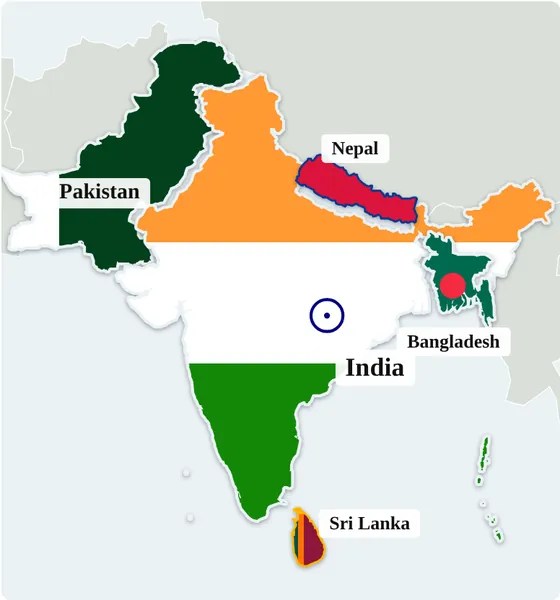
Most Americans, and most South Asians too, still picture the region as it was 25 years ago. NEW South Asia looks at India, Pakistan, Bangladesh, Sri Lanka and Nepal, and at their diasporas in America, as they are today.
Expectations
Then (2000)
Underestimated.
Now
Overestimated.
The diaspora
Then (2000)
Faced and overcame discrimination.
Now
Admired, envied and presumed brilliant, but shadowed by visa abuses and fraud convictions.
Direction
Then (2000)
Looking forward, and to the West for modernity and growth.
Now
Increasingly looking back and inward, toward nationalism and glorified pasts.
America
Then (2000)
Champion of globalization and an open world order.
Now
America First: transactional, country by country.
Latest analysis: Coca-Cola’s India IPO: a good deal for whom?. The editor also comments on news from the five countries and on how the American press covers them. Read the latest commentary.
How much South Asia matters to America
In 2000, Washington saw the region mainly through the lens of the 1998 nuclear tests. Today, South Asia is an economic partner and is a reluctant and ambiguous strategic partner.
America has changed too. In 2000 it was the confident champion of globalization, free trade and an American-led world order. Today it has returned to an “America First” posture closer to its outlook before World War II, with less appetite, and fewer resources, for running the world order. Through Trump’s first term, Biden’s term and Trump’s second, Washington has dealt with each South Asian country on its own merits rather than as part of a regional or global design. Biden spoke the language of alliances but kept Trump’s tariffs and added his own industrial policy. In the editor’s view, this approach will outlast Trump.
U.S. trade in goods
Then (2000)
$22 billion, 1.1% of U.S. goods trade
Now (2025)
$173 billion, 3.1%
Students at U.S. colleges
Then (2000/01)
70,000, 13% of all foreign students
Now (2024/25)
425,000, 36%
Americans of South Asian origin
Then (2000)
2.2 million, 0.8% of the population
Now (2023)
6.5 million, 1.9%
Figures combine India, Pakistan, Bangladesh, Sri Lanka and Nepal. India accounts for most of each: about 86% of the trade (65% in 2000), 85% of the students (78%) and 80% of the diaspora (87%). In 2000, India mattered to Washington mainly as a security concern after its nuclear tests, not yet as an economic partner.
America’s strategic courtship of India is real but uneasy. America lifted most of its 1998 sanctions in 2001 and, with the 2008 civil nuclear agreement, broke with America’s own nonproliferation rules to accept India informally into the nuclear club. America hoped India would become a potential ally and counterweight to China, and the two are partners in the Quad with Japan and Australia. Yet India remains a reluctant partner: India is an active member of BRICS and promotes trade in national currencies, even while rejecting a BRICS common currency. In that bloc, China and Russia push an anti-Western and de-dollarization agenda.
America’s view of Pakistan has swung more than its view of any other country in the region. After 9/11, Pakistan became a frontline partner in the War on Terror and, in 2004, a Major Non-NATO Ally. In 2011, Osama bin Laden was found living in Abbottabad, near Pakistan’s military academy, and many in Washington came to see Pakistan as a duplicitous ally. In April 2026, Pakistan brokered a ceasefire between the United States and Iran. Meanwhile, Pakistan has welcomed heavy Chinese lending for highways and ports under the China-Pakistan Economic Corridor, part of China’s Belt and Road Initiative. Its economy is kept afloat by repeated IMF bailouts, which need American support, and by Saudi deposits. Unlike 25 years ago, America does not quite know what to make of Pakistan.
Bangladesh’s rise came through garments. In 2000 its garment industry was held back by import quotas; after the quotas ended in 2005, it grew into one of the world’s largest garment exporters, with American retailers among its biggest customers. U.S. imports from Bangladesh, mostly clothing, rose from $2.4 billion in 2000 to $9.5 billion in 2025. Long seen as stable and growing, though increasingly authoritarian under Sheikh Hasina, Bangladesh was upended when mass protests drove her from power in August 2024. Its economy has since weakened. Even with an elected government in office since February 2026, Bangladesh has become another hot spot requiring American focus, especially given China’s overtures.
Trade figures cover goods only. Services trade, notably India’s software and business-services exports to the United States, is large but is left out because consistent official figures back to 2000 are not available for all five countries.
Diaspora counts include people who report the origin alone or in combination with another, so a person of two of these origins may be counted twice.
Sources: U.S. Census Bureau, trade in goods with India, Pakistan, Bangladesh, Sri Lanka, Nepal and all countries; Institute of International Education, Open Doors 2002 and 2025 reports; 2000 Census via SAALT; 2023 American Community Survey via Pew Research Center; U.S.–Iran ceasefire: New Straits Times, April 8, 2026.
The five countries in proportion
India dominates the region by sheer size, and the region holds far more of the world’s people than of its output. That gap is a story Americans rarely see.
People: 1.93 billion
India 75%
Economic output: $4.73 trillion
India 80%
The five together, as a share of the world
Nearly one person in four lives in these five countries, which produce about one dollar in every twenty-four of world output.
2024 figures. GDP in current U.S. dollars. Source: World Bank, World Development Indicators. Refreshed once a year; each country page has more.
America, South Asia and the media in the middle
Think tanks
Washington research institutions whose South Asia work shapes policy debates.
- Brookings Institution
- Center for Strategic and International Studies
- Carnegie Endowment for International Peace
- Council on Foreign Relations
- Hudson Institute
- Stimson Center
Inclusion is not an endorsement.
The media bridge
U.S. and U.K. outlets: New York Times, Wall Street Journal, Washington Post, The Economist, The Guardian, Reuters, Bloomberg, BBC
South Asian outlets: Times of India, NDTV, Dawn, The Daily Star, Kathmandu Post, Daily Mirror (Colombo)
Information flows both ways, and gets translated, and often distorted, on the way.
Premise · First written June 2023 · Updated October 2026
“South Asia” is a useful word in some rooms and a misleading one in others.
The label carries two competing claims. One says these countries are close cousins. The other says they are rivals with little in common. Both are partly true. The mistake is applying either one everywhere.
Where the shared identity is real
Among the diaspora in America
Families from India, Pakistan, Bangladesh, Sri Lanka and Nepal share food, languages, music, film, cricket, and centuries of intertwined history. Their American children are often seen, and see themselves, through one lens. Here, a common platform makes sense, though not to everyone: many Indian Americans reject the “South Asian” label and identify simply as Indian American.
Where it misleads
In foreign policy and analysis
America deals with five sovereign states with different economies, alliances and interests, some of them locked in long-running disputes with one another. Grouping them on one desk, or “hyphenating” India and Pakistan, distorts U.S. choices on defense, trade and technology. Here, each country deserves its own file.
The editor’s own view goes further. Every person is an individual, shaped by family, faith, language, profession, place and much else, and no single one of these defines anyone. People do flock together, birds of a feather, but the feather changes with the setting. An Indian-born engineer and a Pakistani-born one may share a lunch table in Atlanta, then cheer for opposite sides in a cricket match or argue opposite sides on Kashmir. Nations behave much the same way, joining together when their interests align and pulling apart when they don’t, as the strains inside the European Union show. So this site uses labels like “Desi” or “South Asian” where they describe a shared experience, never as a definition of who anyone is.
Latest commentary
The editor’s comments on news from the five countries and on how the American press covers them, newest first. Each comment links to the reporting it discusses.
-
Driving Through Fog: Eyes Wide Shut
You can see everything, can you? Amy Chozick’s New York Times op-ed on the Elizabeth Holmes documentary shows how reporters, filmmakers and audiences see what they want to see.
-
Coca-Cola’s India IPO: a good deal for whom?
Coca-Cola’s Indian bottler is heading for a $1 billion IPO that will mostly pay existing owners. Indian savers helped finance the stake at a lower price and may now be asked to buy shares at a far higher one.
-
The revolution no one predicted: Vivek Wadhwa’s strawman op-ed in Hindustan Times
Our friend, Vivek Wadhwa, has just written an op-ed in Hindustan Times. He attacks the Western media and the diaspora for predicting a revolution that major Western outlets never forecast.
-
Delhi is not Paris: the false equivalence behind India’s protest crackdown
Some of India’s most-watched channels say India is handling its protests better than France. The facts point the other way: Delhi saw far less disorder but far more detentions, most of them before anything happened.
-
Big Take Asia: How India’s options market imploded
Bloomberg · Big Take Asia: How India’s options market imploded This is a podcast interview (part of Bloomberg’s Big Take Asia podcast series). It summarizes the facts of India’s options boom and bust well, but the podcast misjudges a few…
-
India’s Election Commission controversy: a chronology
A plain-language, dated account of the Special Intensive Revision, the West Bengal deletions, the objections inside the Election Commission and the Supreme Court’s response.
About the site
NEW South Asia is designed to help Americans see India, Pakistan, Bangladesh, Sri Lanka and Nepal as they are today: five distinct countries, each with its own economy, politics and relationship with the United States. The site carries the editor’s commentary on selected news and on the region, and follows how American media coverage of the region is changing, so that readers, businesses and policymakers can deal with each country on its own terms rather than through images left over from the last century.
The site is a gateway to great media organizations, not a substitute for them. Each comment links to the original reporting so that readers support the newsrooms that do the work. Its purpose is informational, not advocacy and not commercial. The choice of stories, and the views expressed, inevitably reflect the editor’s own judgment.
South Asia is usually defined as eight countries: Afghanistan, Bangladesh, Bhutan, India, the Maldives, Nepal, Pakistan and Sri Lanka. This site covers five. Afghanistan has had extensive American attention since the Soviet invasion of 1979 and two decades of U.S. involvement. Bhutan and the Maldives, each with fewer than a million people, are too small to cover in depth.

Who runs this site
John Laxmi, editor
NEW South Asia is edited by John Laxmi from Atlanta, Georgia. Born in India, he immigrated to the United States in 1978, became an American citizen, and writes from an American point of view.
His view of the region is shaped first by a career in global finance, especially his extensive dealings with governments and business enterprises in developed and developing countries worldwide. He started his finance career in the public sector, serving as the Budget Planning Director of the State of West Virginia and as the Finance Director of West Virginia’s state housing agency. He then spent 16 years in investment banking at Morgan Stanley and Citi. After an early retirement from investment banking, during a mid-career sabbatical, he taught a course on bond markets at New York University’s School of Continuing and Professional Education. In 2005 he co-founded Alinda Capital Partners, a multi-billion-dollar private equity firm, and served as its Chief Operating Officer.
Alongside that career, he served for nearly 25 years on the board of the South Asian Journalists Association, including as its Treasurer, and now advises the board. His association with SAJA exposed him to the world of journalism and, especially, gave him a close view of how American newsrooms cover the region.
He also produces Zoom Out, a series of short explanatory videos on finance, economics and international affairs, published on LinkedIn and YouTube.
NEW South Asia is an independent project. It is not affiliated with the South Asian Journalists Association or any other organization named here, and the views expressed are his own.
Join the editor’s email group
The site’s editor also runs NewSA-USA, a moderated email group that sends a handful of news stories on the region each day, each with a link to the original and, often, a short comment. The site carries only a selection of those comments. Membership in the email group is free.


The editor reviews each request and adds you to the group; a welcome email from Google Groups follows. No Google account is needed. You can also ask to join by sending any email to newsausa+subscribe@googlegroups.com.
To leave the group at any time, use the link at the bottom of any group email, or write to newsausa+unsubscribe@googlegroups.com.

